Aluminum Injection
Lightweight and efficient aluminum tooling solutions designed for rapid prototyping, low-volume production, and faster product development with excellent thermal performance and precision.
High-Performance Coatings for Plastic and Aluminum Injection Molding
We provide advanced mold coating solutions for plastic injection molding, aluminum die casting, and non-ferrous metal applications. Our coatings reduce wear, adhesion, and thermal damage while improving mold durability and production stability.
Our customized coating systems are designed for different plastics, fillers, and metal alloys to enhance demolding performance and product quality. With high-temperature resistance and multi-layer protection technology, our solutions help reduce maintenance costs and extend mold service life.
Solutions to your problems
Coatings for Plastic Injection Molding

Advanced coatings improve mold performance by reducing wear, sticking, and surface damage during plastic injection.
- High hardness for better wear resistance
- Low reactivity to reduce material adhesion
- Corrosion resistance for longer mold life
- Low friction for smoother demolding
Non-Ferrous Injection Coatings

Specialized coatings protect molds against high temperatures, sticking, and thermal stress in aluminum and zinc alloy casting.
- High hardness for extreme conditions
- Low reactivity to prevent sticking
- Multi-layer structure for thermal protection
- High heat resistance for stable production
Coating Recommendation
Our specialists recommend suitable coating solutions based on materials, applications, and mold surface requirements.
- Customized coating selection
- Professional surface preparation
- Solutions for complex mold conditions
- Improved production efficiency
- 24/7 emergency call support (limited)
Bridge Tooling Solutions for Faster Product Development
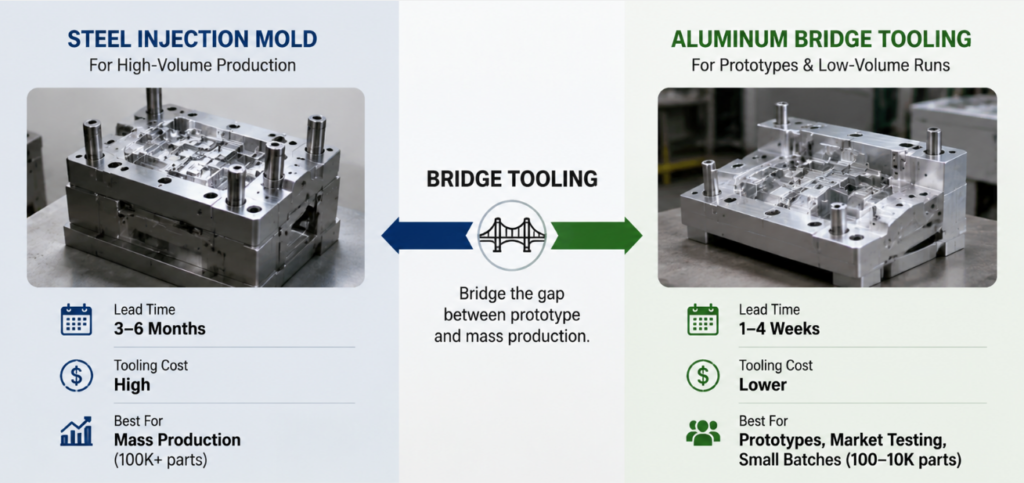
Bridge tooling provides a practical solution between prototype development and mass production, helping manufacturers shorten development cycles and accelerate product launches. It offers a flexible approach by combining rapid tooling capabilities with reliable injection molding performance.
Aluminum bridge tooling is ideal for prototypes, market testing, and low-volume production, offering shorter lead times and lower tooling costs compared with traditional steel molds. It enables companies to quickly validate designs, test product performance, and optimize products before full-scale manufacturing.
For high-volume production, steel injection molds provide excellent durability, wear resistance, and long-term stability. By selecting the right tooling solution based on production volume, application requirements, and budget, customers can achieve the best balance of speed, cost, and manufacturing efficiency.
Aluminum Alloy for Precision Tooling
7075-T6 aluminum alloy is a high-strength material designed for precision mold manufacturing, offering excellent strength, dimensional stability, and machining performance. It is widely used for tooling applications that require reliable performance and lightweight advantages.
With superior hardness, wear resistance, and structural stability, 7075-T6 aluminum helps molds maintain accuracy during repeated production cycles. It is an ideal choice for prototype tooling, bridge molds, and low-to-medium volume injection molding applications.

Aluminum vs. Steel Injection Molding: A Strategic Comparison
| Tooling Material | Thermal Conductivity (W/m·K) |
Machinability | Typical Tool Life (Shot Count) |
Key Advantages | Recommended Application |
|---|---|---|---|---|---|
| Aluminum 7075-T6 | ~130 | Excellent | 5,000 – 10,000 | High strength, lightweight structure, excellent dimensional stability, easy machining. | Bridge tooling, complex parts, low-to-medium volume injection molding. |
| QC-10 Aluminum | ~160 | Excellent | 2,000 – 5,000 | Outstanding thermal performance and ultra-fast machining capability. | Rapid prototyping, functional prototypes, short production runs. |
| P20 Tool Steel | ~30 | Good | 50,000 – 500,000+ | Excellent durability, wear resistance, and long-term production stability. | High-volume injection molding and mass production tooling. |
Engineering Best Practices for Aluminum Mold Design (DFM)
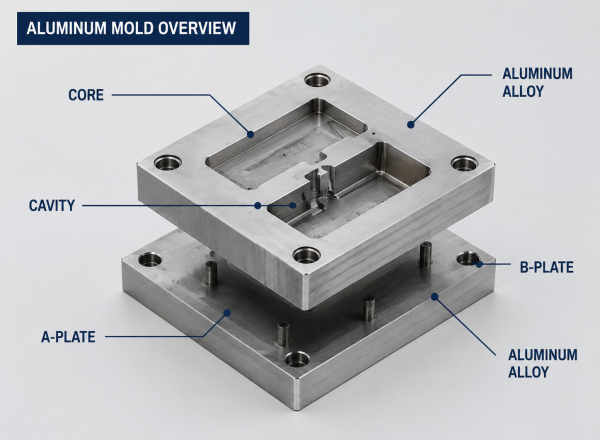
Aluminum Mold Structure for Lightweight and Efficient Tooling
Aluminum molds feature a precision-engineered structure with core, cavity, A-plate, and B-plate components to ensure accurate molding performance. Made from aluminum alloy, these molds offer lightweight design, excellent thermal performance, and fast processing efficiency for prototype and low-volume injection molding applications.
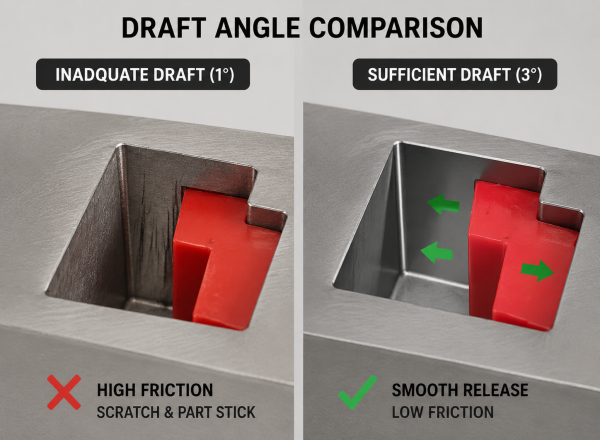
Optimized Draft Angle Design for Better Mold Performance
Proper draft angle design ensures smooth demolding, reduces friction, and prevents part sticking or surface damage. By optimizing mold geometry, manufacturers can achieve higher efficiency, consistent part quality, and longer mold service life.
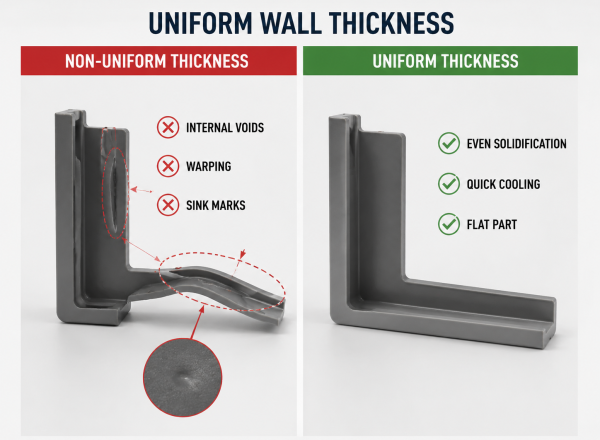
Uniform Wall Thickness for High-Quality Injection Molding
Maintaining uniform wall thickness is essential for stable injection molding performance. Proper design helps ensure even cooling, reduce warping, prevent sink marks and internal defects, and achieve consistent part quality with improved dimensional accuracy.
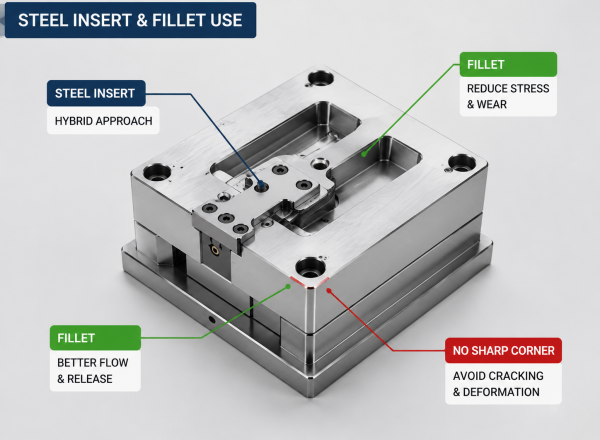
Steel Inserts and Fillet Design for Enhanced Mold Durability
The use of steel inserts and optimized fillet design improves mold strength, reduces stress concentration, and enhances wear resistance. Proper corner design helps prevent cracking and deformation, ensuring smoother material flow and longer tooling life.
| Design Factor | Engineering Approach | Customer Benefits |
|---|---|---|
| Draft Angle Optimization | We optimize draft angle design based on part geometry and material characteristics to ensure smooth demolding and reduce surface damage. | Lower friction, fewer defects, and improved production consistency. |
| Uniform Wall Thickness | Advanced mold analysis helps maintain uniform wall thickness for balanced cooling and stable filling performance. | Reduced warping, fewer sink marks, and improved dimensional accuracy. |
| Steel Inserts & Fillet Design | Strategic use of steel inserts and fillet structures improves stress distribution and enhances mold durability. | Extended tool life, improved reliability, and reduced maintenance requirements. |
| Aluminum Mold Structure | Precision-machined aluminum alloy tooling provides lightweight performance with excellent thermal efficiency. | Faster production cycles, shorter lead times, and cost-effective tooling solutions. |
Factory-Direct vs. Brokers: Sourcing Your Aluminum Molds Safely
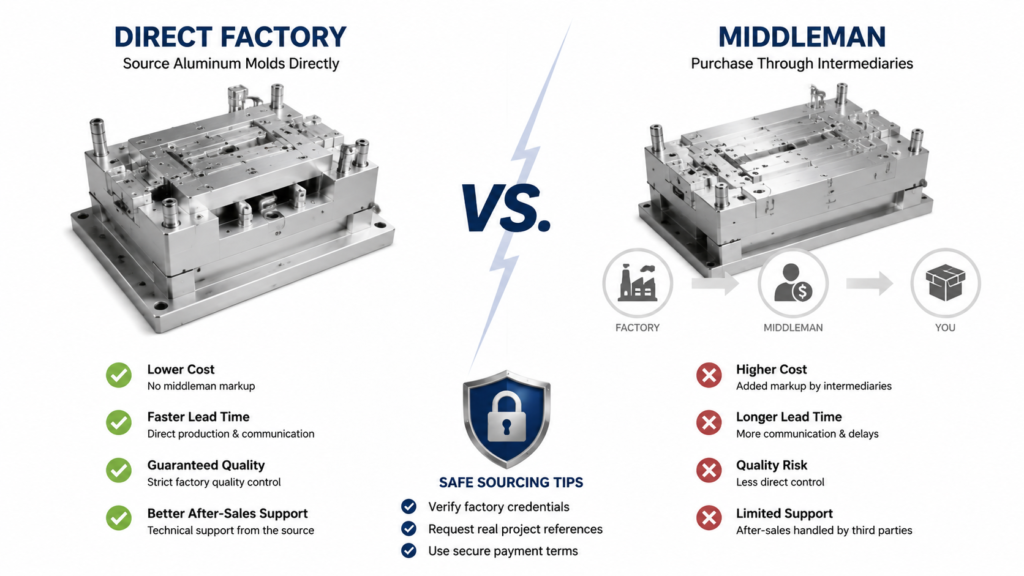
Working directly with a professional mold manufacturer eliminates unnecessary intermediaries and provides more competitive pricing. Our direct factory supply model ensures transparent communication, efficient project coordination, and better control over every production stage.
By cooperating directly with our engineering and production teams, customers benefit from faster response times, shorter communication cycles, and quicker project adjustments. This helps reduce delays and ensures smoother execution from design review to final delivery.
As the original manufacturing source, we maintain strict quality control throughout the entire tooling process. Our experienced engineers and production teams ensure consistent mold quality, precision manufacturing, and reliable performance for every project.
Beyond manufacturing, we provide long-term technical support and after-sales service to help customers solve application challenges. Choosing a direct factory partner means gaining better value, reliable quality, and continuous support throughout the product lifecycle.
FAQ
What is vacuum deposition?
Vacuum deposition is a surface treatment used to deposit a material or alloy on a mechanical part.
The use of vacuum technology ensures a perfectly clean, non-polluting process.
What are the advantages of PVD technology?
This process significantly increases resistance to wear, abrasion, and friction. As a result, the service life of the components is greatly extended.
Standard thicknesses are of the order of 3µm and deposition is carried out on finished parts.
What's the difference between PVD and PACVD?
PVD stands for physical vapor deposition. The material to be deposited is produced by evaporation or atomization through a physical process. PACVD stands for plasma-assisted chemical vapor deposition. The material to be deposited is produced through chemical reactions. The plasma allows this chemical reaction to occur at a lower temperature.
Can I use CAD software for sheet metal design?
Yes, many CAD software programs have specific features for designing sheet metal components, including bend allowances and flat patterns.
What design considerations should I focus for sheet metal parts?
Consider factors like bend radius, material thickness, tolerances, and the intended manufacturing process to optimize design for fabrication.
How do I estimate the cost of sheet metal fabrication?
Costs are influenced by material type, thickness, complexity of the design, quantity, and labor involved. Requesting quotes from fabricators can provide clearer estimates.
CNC Machining Design Guide
Essential Design Tips for Engineers & Buyers to Ensure Quality Machined Parts
- Design for Manufacturability (DFM)
- Tolerance & Dimensional Control
- Surface Finish Selection
- Common Design Pitfalls to Avoid
- Material & Process Optimization
- Cost & Production Efficiency Consideration