
CNC machining tools are precision cutting instruments designed to remove, shape, drill, and finish materials during CNC machining operations. Common examples include end mills, drills, face mills, taps, and other specialized cutting tools engineered for high accuracy and efficiency. These tools play a critical role in determining the quality, surface finish, and overall performance of machined components.
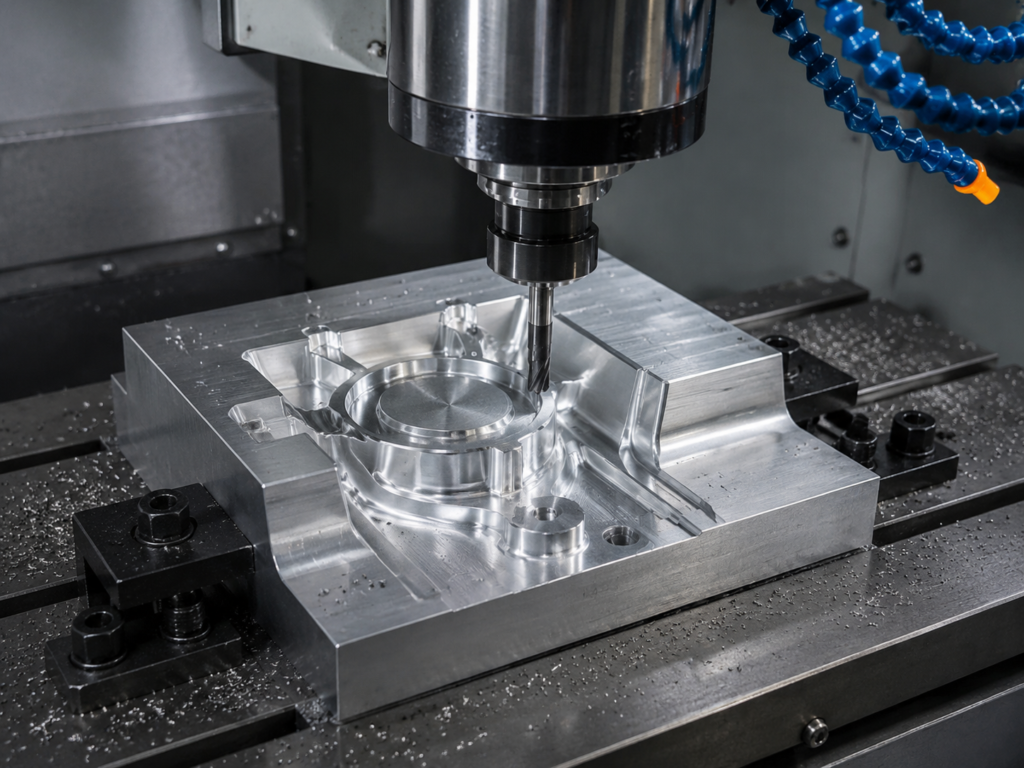
In modern CNC manufacturing, machining tools are essential for transforming raw materials such as aluminum, steel, stainless steel, titanium, and plastics into complex and precise parts. Each tool type is developed for specific machining processes, including milling, drilling, turning, threading, and finishing, with factors such as tool geometry, material composition, and coating technology directly affecting cutting performance and tool life.
This guide provides a comprehensive overview of CNC machining tools, covering their different types, applications, materials, coatings, and key factors for selection. Whether you are a CNC machinist, manufacturing engineer, machine shop owner, or industrial buyer, understanding how these tools work and how to choose the right solution is essential for improving machining efficiency, reducing production costs, and achieving consistent part quality across various industries.
What Are CNC Machining Tools?
CNC machining tools are the precision cutting components responsible for shaping, drilling, boring, and finishing workpieces during CNC manufacturing processes. Common examples include drills, end mills, turning inserts, taps, reamers, and other specialized cutting tools. These tools are mounted on a CNC machine’s spindle or turret and follow programmed toolpaths generated through CAD/CAM software to produce highly accurate components. Without the proper tooling solution, even a perfectly optimized CNC program may result in poor surface quality, dimensional errors, excessive tool wear, or complete part failure.
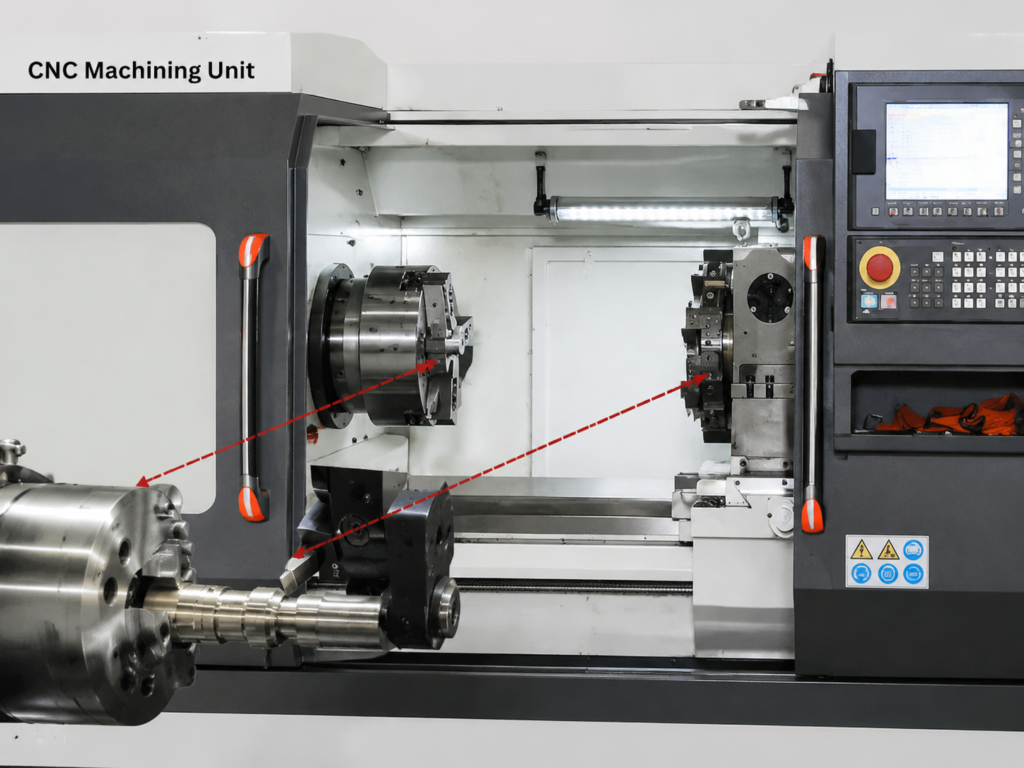
The performance of CNC machining tools varies significantly depending on their design, material composition, coating technology, and intended application. Different machining operations and workpiece materials require specific tool geometries and cutting parameters to achieve optimal results. However, all CNC tools share several essential characteristics: they must maintain higher hardness than the material being machined, withstand extreme cutting temperatures, resist wear, and deliver consistent performance under demanding production conditions.
For machinists, engineers, and manufacturers, selecting the right CNC machining tools is a critical factor in achieving efficient and cost-effective production. The correct tooling choice directly impacts machining accuracy, productivity, tool life, and overall manufacturing costs. Whether operating a small machine shop or a large-scale industrial facility, understanding CNC tool types and their applications is essential for maximizing machine performance and producing high-quality finished parts.
What Is the Difference Between a CNC Machine and CNC Tools?
A CNC machine and CNC machining tools work together, but they serve different purposes. The CNC machine is the complete automated system that controls movement, speed, and machining operations through components such as the controller, spindle, motors, and software. CNC tools are the interchangeable cutting components, including end mills, drills, taps, and inserts, that directly remove material and create the final part geometry.
Simply put, the CNC machine provides the power, movement, and control, while the cutting tool performs the actual machining work. During production, CNC machines can automatically change between different tools to complete multiple operations, such as milling, drilling, threading, and finishing, with high accuracy and repeatability.
Choosing the right CNC tools is essential for achieving consistent part quality and efficient production. The wrong tool selection can lead to poor surface finishes, faster wear, and increased machining costs. That is why understanding the relationship between CNC machines and machining tools is a key factor in successful CNC manufacturing.
Types of CNC Machining Tools
Cutting Tools
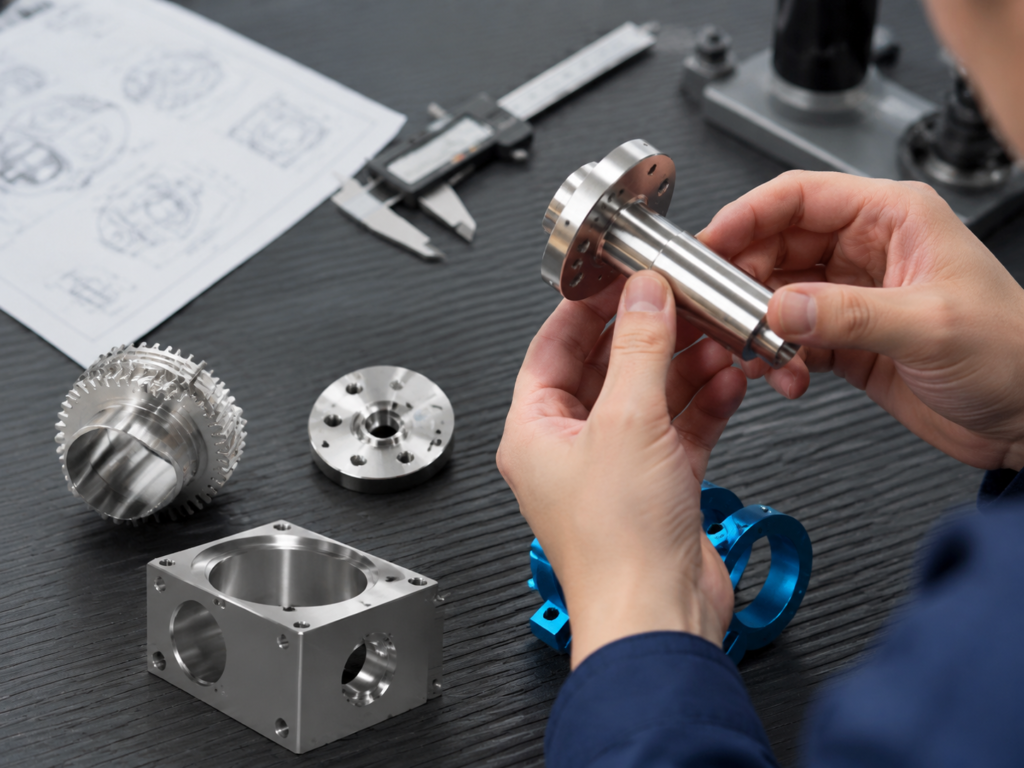
Cutting tools are responsible for removing material from a workpiece during CNC machining. Common types include end mills, drills, face mills, taps, reamers, and turning inserts. Each tool is designed for specific operations, such as cutting, drilling, threading, or finishing, and the right choice depends on the material, machining process, and accuracy requirements.
Non-Cutting Tools
Non-cutting tools do not remove material but help improve machining accuracy and efficiency. They are mainly used for positioning, measurement, setup, and inspection. Examples include edge finders, dial indicators, fixtures, clamps, and sensors, which ensure proper alignment and reliable machining results.
Common Types of CNC Machining Cutting Tools
CNC machining relies on a wide range of cutting tools, each designed for specific operations such as milling, turning, drilling, boring, reaming, and threading. Selecting the right tool type based on the material, machining process, and required accuracy has a direct impact on part quality, production efficiency, and overall machining costs.
| Tool Category | Main Function | Common Tools | Typical Materials |
|---|---|---|---|
| Milling Tools | Material removal from stationary workpieces | End mills, face mills, shell mills, fly cutters | Metals, plastics, wood |
| Turning Tools | Machining rotating workpieces on CNC lathes | Roughing inserts, finishing inserts, grooving tools, knurling tools | Aluminum, brass, steel, cast iron |
| Hole-Making Tools | Creating precise holes | Twist drills, carbide drills, center drills | Metals, plastics, composites |
| Boring Tools | Enlarging and finishing existing holes | Boring bars, adjustable boring heads | Metals, cast iron |
| Reaming Tools | Improving hole accuracy and surface finish | Machine reamers, hand reamers | Metals, plastics |
| Threading Tools | Producing internal and external threads | Taps, thread mills, forming taps | Aluminum, steel, brass |
Milling Tools
Milling tools are among the most commonly used CNC machining tools. Mounted on the machine spindle, these cutters rotate at high speed while following programmed toolpaths to remove material and create complex part features. The correct milling tool selection can significantly improve machining accuracy, surface finish, tool life, and production efficiency.
End Mills
End mills are versatile CNC cutting tools with cutting edges on both the end face and the side of the tool. Unlike standard drills, they can perform multiple operations, including slotting, pocketing, profiling, contouring, and plunging. Different end mill geometries are selected based on the machining application and workpiece requirements.
Common end mill types include:
- Square End Mills – Designed for general-purpose milling, including slots, pockets, and sharp-corner features.
- Ball Nose End Mills – Feature a rounded cutting edge ideal for 3D contour machining, curved surfaces, and complex geometries.
- Bull Nose End Mills – Combine a flat end with corner radii to improve tool strength and reduce edge wear during pocketing operations.
- Chamfer Mills – Used for creating beveled edges, deburring, and preparing holes before drilling operations.
Flute Selection:
The number of flutes affects chip removal, cutting speed, and surface finish. Two- or three-flute end mills are commonly used for softer materials such as aluminum because they provide better chip evacuation. Four- to six-flute designs are often preferred for harder materials where improved surface finish and tool stability are required.
Face Mills, Shell Mills, and Fly Cutters
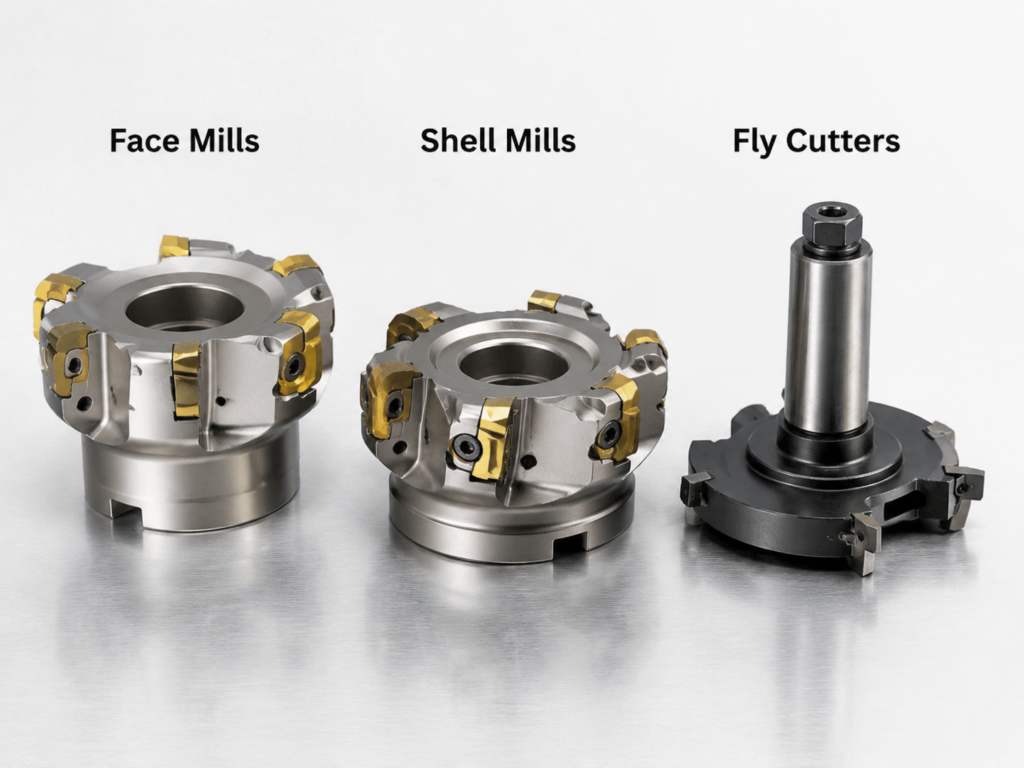
Face mills and shell mills are designed for high-efficiency surface machining. Instead of a single cutting edge, they use multiple carbide inserts that can be individually replaced when worn, helping manufacturers reduce tooling costs and improve production efficiency.
- Face Mills – Used for machining large flat surfaces quickly and efficiently, making them ideal for high-volume manufacturing applications.
- Shell Mills – Similar to face mills but typically mounted using an arbor system for heavy-duty milling operations.
- Fly Cutters – Single-point cutting tools that provide excellent surface finishes at lower machining speeds, making them suitable for prototypes, small-batch production, and precision finishing work.
Turning Tools (Lathe Tools)
Turning tools are essential cutting tools used in CNC lathe operations, where the workpiece rotates while a stationary tool moves along a programmed path to remove material. This machining process is widely used in industries such as aerospace, automotive, and precision manufacturing, where tight tolerances, excellent surface finishes, and high dimensional accuracy are required.
Most CNC turning operations rely on indexable inserts mounted in toolholders and secured on the machine turret. Selecting the right turning tool depends on factors such as material type, cutting conditions, production requirements, and tool life. The proper tooling choice directly affects machining efficiency, part quality, and overall manufacturing costs.
Roughing Inserts
Roughing inserts are designed for high-volume material removal. They use strong cutting edges and aggressive cutting parameters to remove large amounts of stock quickly. While they prioritize cutting efficiency and tool strength over surface finish, they are ideal for the initial stages of turning operations. Certain ceramic insert grades can also be used for high-speed rough machining of specific materials.
Finishing Inserts
Finishing inserts are engineered for precision machining and achieving superior surface quality. With sharper cutting edges and optimized geometries, they operate at higher cutting speeds, lower feed rates, and smaller depths of cut to produce accurate dimensions and smooth surface finishes on finished components.
Grooving and Parting Tools
Grooving tools feature narrow cutting edges designed to create precise grooves on rotating workpieces. They are commonly used for applications such as O-ring grooves, retaining ring slots, and undercut features. Parting tools work in a similar way by cutting radially into the workpiece to separate the completed component from the remaining bar material.
Knurling Tools
Knurling tools create textured patterns on the surface of a rotating workpiece by pressing hardened wheels against the material. Unlike cutting tools, knurling does not remove material; instead, it forms the pattern through controlled surface deformation. Common knurling patterns include straight, diagonal, and diamond designs, often used to improve grip and enhance the appearance of machined parts.
Drilling Tools
Drilling tools are among the most commonly used CNC cutting tools for creating accurate holes in a wide range of materials. During the drilling process, a rotating tool advances along its axis into the workpiece to remove material. On CNC machining centers, the spindle rotates the drill while the Z-axis controls the feed movement. In CNC turning operations, the workpiece rotates while the cutting tool remains fixed.
Choosing the right drill type depends on factors such as material hardness, hole depth, accuracy requirements, and production volume.
Common Types of Drill Bits
Twist Drill (HSS)
High-speed steel (HSS) twist drills are widely used for general-purpose drilling applications. They offer excellent toughness, good heat resistance, and easy resharpening capabilities, making them suitable for softer materials such as aluminum, brass, and mild steel.
Carbide Drill
Carbide drills provide higher hardness and wear resistance compared with HSS tools, allowing them to operate at higher cutting speeds. However, they are more brittle and require rigid machines and stable cutting conditions to prevent tool damage.
Ejector Drill
Designed for deep-hole machining, ejector drills feature internal cooling channels and efficient chip removal systems. They reduce the need for peck drilling and improve productivity in high-volume manufacturing environments.
Center Drill / Spot Drill
Center drills and spot drills are used before drilling to accurately locate the hole position and prevent the main drill from drifting. Their short and rigid design provides better stability during high-speed operations.
Boring Tools
Boring tools are used to enlarge and finish existing holes where higher accuracy, improved roundness, and tighter tolerances are required. Unlike drilling, boring does not create a new hole but improves the precision and surface quality of a previously machined opening.
Boring operations are widely used in industries such as aerospace, automotive, and heavy equipment manufacturing, where precision components such as bearing housings and hydraulic parts require strict dimensional control.
Common Types of Boring Tools
Fixed Boring Bar
Fixed boring bars are preset to a specific diameter and are ideal for high-volume production where consistent hole sizes are required. They provide excellent repeatability and efficient CNC automation performance.
Adjustable Boring Head
Adjustable boring heads allow operators to fine-tune cutting diameters with high precision. They are commonly used for prototypes, small batches, and applications requiring frequent size adjustments.
Reaming Tools
Reaming tools are precision finishing tools used after drilling or boring to achieve accurate hole dimensions and improved surface finishes. A reamer removes only a small amount of material, typically used as the final step for producing holes with tight tolerances.
Common Types of Reamers
Machine Reamer
Machine reamers are driven by CNC machines and are commonly used in production environments where consistent hole accuracy is required.
Hand Reamer
Hand reamers are manually operated and are suitable for repair work, assembly adjustments, and low-volume machining applications.
Threading Tools
Threading tools are used to create internal and external threads in machined components. The best threading method depends on the material, hole type, thread specifications, and production requirements.
Common Threading Tools
Spiral Point Tap
Spiral point taps push chips forward, making them ideal for through holes where chips can easily exit the workpiece. They provide fast and efficient threading performance.
Spiral Flute Tap
Spiral flute taps pull chips upward and out of the hole, making them suitable for blind holes where chip evacuation is more challenging.
Forming Tap
Forming taps create threads by displacing material rather than cutting it, producing stronger threads with improved surface integrity. They are commonly used for ductile materials such as aluminum, brass, and mild steel.
Thread Mill
Thread mills use a rotating cutter that follows a helical path to produce threads. They offer excellent flexibility, reduce the risk of tool breakage, and are often preferred for large threads, difficult materials, or high-value components.
Important Non-Cutting CNC Tools
Measurement Tools
Accurate measurement is essential for maintaining machining quality and process consistency. Common CNC inspection tools include:
| Tool | Purpose | Typical Accuracy |
|---|---|---|
| Digital Caliper | Measuring external dimensions, internal diameters, depth, and steps | 0.01 mm |
| Micrometer | High-precision external measurement | 0.001 mm |
| Dial Test Indicator | Checking alignment, runout, and machine setup accuracy | 0.01 mm |
| Dial Bore Gauge | Measuring internal hole diameter | 0.001 mm |
| Thread Pitch Gauge | Identifying thread specifications | Visual comparison |
Measurement tools such as dial test indicators play an important role during CNC machine setup. They help verify fixture alignment, check tool runout, and ensure accurate workpiece positioning before machining begins.
Workholding Tools
Workholding tools secure the workpiece during machining to prevent movement and maintain accuracy throughout the production process. A reliable fixture setup improves repeatability, reduces errors, and supports efficient CNC operations.
Common Workholding Tools
Clamps
Used to secure parts directly to machine tables or fixture plates while keeping cutting paths clear.
1-2-3 Blocks and Parallels
Precision-ground supports used for positioning and holding workpieces in vises or fixtures.
Edge Finders
Spindle-mounted tools used to accurately locate workpiece edges and establish machining coordinates before cutting.
How Does a CNC Tool Work?
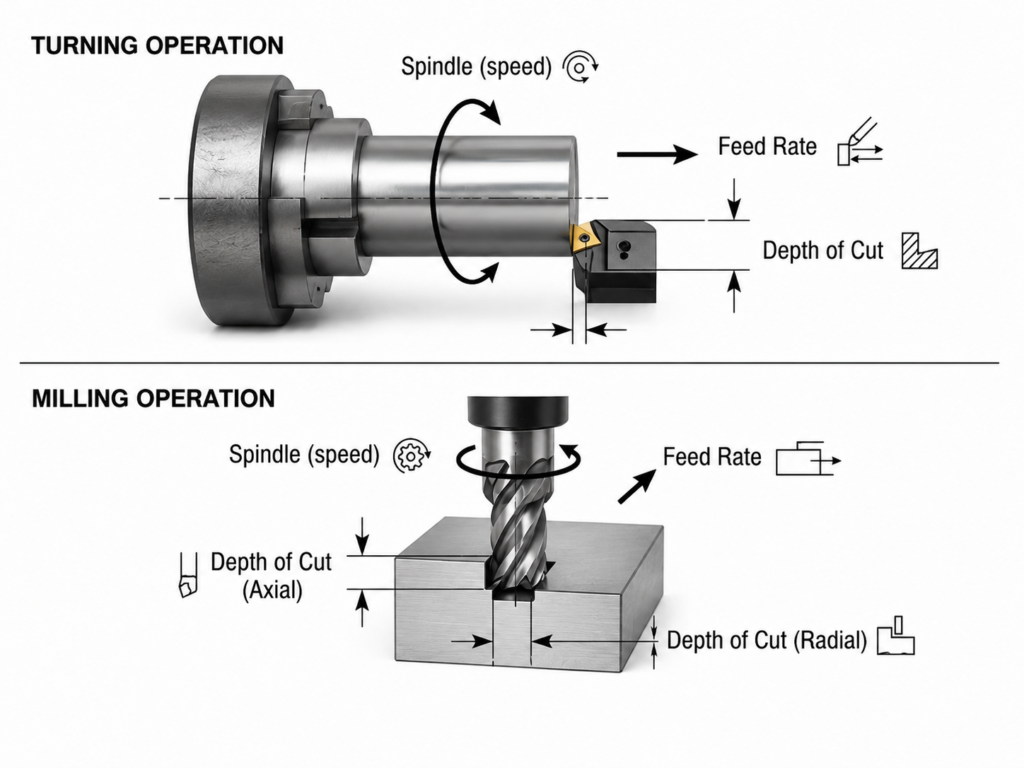
CNC machining tools operate through a combination of computer-controlled movements, cutting parameters, and precision tool design. The process starts with a CAD model, which is converted into machining instructions through CAM software. The generated G-code is then transferred to the CNC controller, which controls the spindle movement, tool paths, and cutting operations with high accuracy.
During machining, the cutting tool follows the programmed path while removing material from the workpiece. The overall machining performance depends on factors such as tool geometry, workpiece material, spindle speed, feed rate, and cutting depth.
The three key machining parameters include:
- Spindle Speed (RPM): Controls how fast the tool rotates and affects cutting efficiency and tool wear.
- Feed Rate: Determines the speed at which the tool moves through the material and influences chip formation and surface finish.
- Depth of Cut: Defines the amount of material removed during each machining pass.
Proper control of these parameters helps manufacturers achieve better accuracy, longer tool life, and stable production results.
CNC Tool Materials
The material of a CNC tool plays an important role in its hardness, wear resistance, cutting speed, and application range. A cutting tool must be harder than the workpiece material to maintain sharpness and performance during machining.
| Tool Material | Features | Common Applications |
|---|---|---|
| High-Speed Steel (HSS) | Tough, cost-effective, and easy to resharpen | Drilling, tapping, reaming, general machining |
| Tungsten Carbide | High hardness, excellent wear resistance, suitable for high-speed cutting | Milling, turning, precision machining |
| PCD / CBN | Extremely hard and heat resistant | Hard materials and high-precision finishing |
HSS tools are widely used because of their toughness and versatility, especially in workshops handling different materials and machining conditions.
Carbide tools are the preferred choice for modern CNC manufacturing due to their higher cutting speeds, longer tool life, and better performance on difficult materials. However, carbide requires stable machines and proper cutting conditions because of its lower impact resistance.
CNC Tool Coatings
Tool coatings improve machining performance by reducing friction, increasing heat resistance, and extending tool life. Common coating technologies include PVD and CVD, which add a protective layer to carbide and HSS tools.
| Coating | Advantages | Typical Applications |
|---|---|---|
| TiN | Good wear resistance and reduced friction | General milling and drilling |
| TiAlN / AlTiN | Excellent thermal stability and oxidation resistance | Stainless steel, titanium, hardened materials |
| DLC | Low friction and prevents material adhesion | Aluminum, copper, graphite |
Selecting the right coating helps reduce tool wear, improve cutting performance, and maintain consistent machining quality during production.
Selecting CNC Tools Based on Applications
Different machining operations require different tool designs. Choosing the correct CNC tool helps improve efficiency, accuracy, and overall production performance.
| Machining Feature | Recommended Tool |
|---|---|
| Flat surfaces | Face mill, shell mill |
| Slots and pockets | Square end mill |
| 3D contours | Ball end mill |
| Precision holes | Drill and reamer |
| Large or accurate holes | Boring bar |
| Internal threads | Tap or thread mill |
| Chamfers and bevels | Chamfer mill |
For example, end mills are commonly used for slotting, pocketing, and profiling, while ball end mills are ideal for complex 3D surfaces. Precision holes often require additional operations such as reaming or boring to achieve tighter tolerances.
How to Choose the Right CNC Tool?
Selecting the right CNC tool requires careful consideration of the workpiece material, machining operation, required accuracy, production volume, and machine capability.
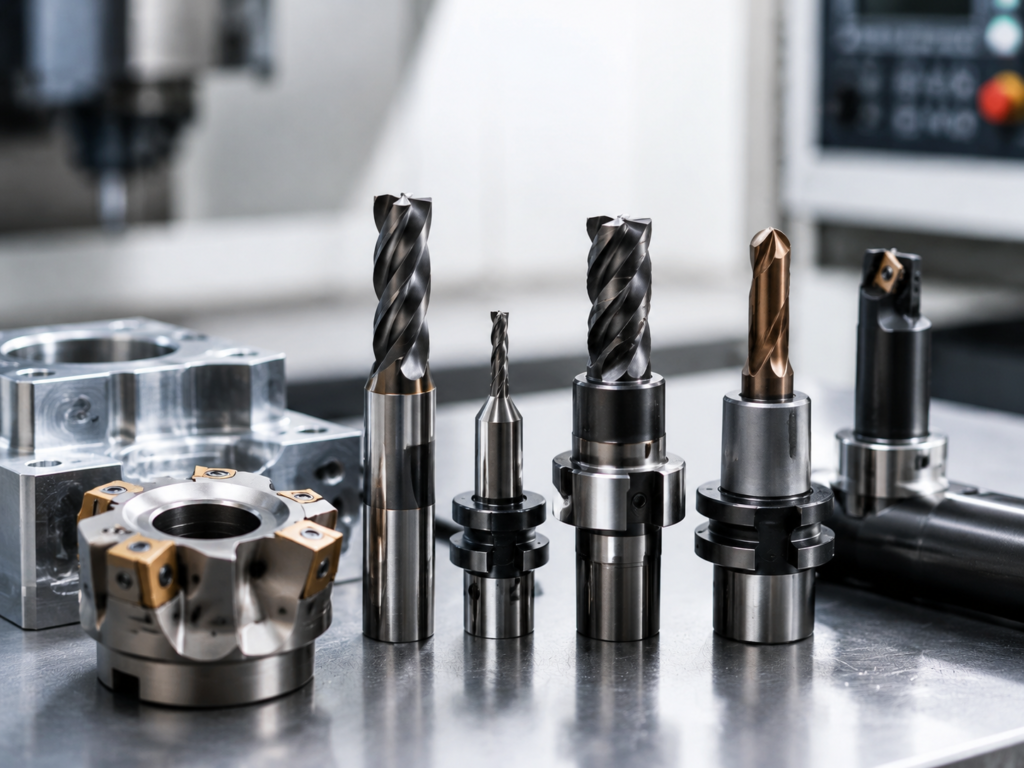
The correct tooling solution can help manufacturers:
- Improve machining efficiency
- Extend tool life
- Achieve better surface finishes
- Reduce production costs
- Maintain consistent part quality
For CNC manufacturers and machining businesses, choosing the right tools is a key factor in achieving reliable, efficient, and cost-effective production.
Conclusion
Selecting the right CNC machining tools for each application is essential for achieving accurate, efficient, and consistent manufacturing results. Factors such as tool material, geometry, coating, cutting parameters, and workpiece characteristics all influence machining accuracy, tool life, production efficiency, and overall cost performance.
For machinists, engineers, and manufacturers, a strong understanding of CNC tooling is the foundation for improving quality and optimizing production processes. As CNC technology continues to advance and automation becomes more widely adopted, choosing the correct tools will remain a critical factor in maximizing machine performance and maintaining a competitive advantage in modern manufacturing.